Plan above from wikipedia
2012 - 2013 Lawrence Lek & Michael Dean
Showing posts with label View. Show all posts
Wednesday, 23 January 2013
Enric Miralles - Scottish Parliament
Diller + Scofidio - Flesh
Here a few drawings from Diller + Scofidio. Check out their seminal publication - 'Flesh'. The book describes a selection of fantastic projects including the Slow House (posted earlier on the blog). Please take a trip to the library and have a look....
Saturday, 29 December 2012
Dan Graham
Daniel "Dan" Graham (born March 31, 1942) is an American artist, writer, and curator.
From wikipedia:
"Dan Graham’s artworks are said to blur the line between sculpture and architecture. Since the 1980s, Graham has been working on an ongoing series of freestanding, sculptural objects called pavilions; they represent a hybrid between a quasi-functional space and an installation that serves to expose processes of perception and certain expectations."
From wikipedia:
"Dan Graham’s artworks are said to blur the line between sculpture and architecture. Since the 1980s, Graham has been working on an ongoing series of freestanding, sculptural objects called pavilions; they represent a hybrid between a quasi-functional space and an installation that serves to expose processes of perception and certain expectations."
Beatriz Colomina - Double Exposure: Architecture as a Machine to See
This lecture by Beatriz Colomina, hosted at the Architectural Association in 2011, explores architecture and photography as machines to see. The lecture was part of a series which addressed the photographic rationalisation and depiction of architectural space and its role as a tool for deciphering the urban environment. i think it would be highly relevant to several of your projects.
Please have a look by following this link: Beatriz Colomina - Double Exposure: Architecture as a Machine to See
You can check out more great lectures from the AA archive online here:http://www.aaschool.ac.uk/public/audiovisual/videoarchive.php
Monday, 24 December 2012
Olafur Eliasson
Here are a selection of works by Olafur Eliasson. From wikipedia: "Olafur Eliasson (born 1967 in Copenhagen, Denmark) is a Danish-Icelandic artist known for sculptures and large-scale installation art employing elemental materials such as light, water, and air temperature to enhance the viewer’s experience. In 1995 he established Studio Olafur Eliasson in Berlin, a laboratory for spatial research. Eliasson represented Denmark at the 50th Venice Biennale in 2003 and later that year installed The Weather Project in the Turbine Hall of Tate Modern, London."
Check out more works here: http://www.olafureliasson.net/works.html
Consider how the spatial implications of these material investigations might relate to your own studies. How might ideas explored in these works inform the experiential characteristics of your propositions?
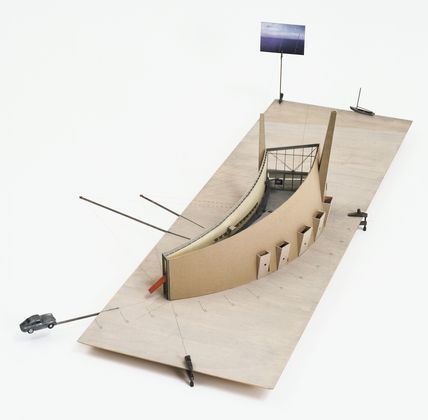
Slow House - Diller Scofidio
The Slow House, a weekend retreat on the Long Island waterfront designed in 1989 for a Japanese Art Investor, is a seminal project by New York based Architects Diller + Scofidio
'Our client came to us and said he wanted a house with a view,' Diller recalls. That request provoked them to explore the very notion of a view -- for instance, the evolution of the picture window and the terminology in real-estate ads. 'Why is architecture a technology that creates a view?' Diller recounts. 'Because it mediates it with a window frame.' The couple argued that the picture window represents a more advanced technology than the video display -- 'because it strips away the hardware that you have on a TV monitor and leaves only the effect'
From here
Above, TV in Picture Window Apparatus
"In this drawing, the architects juxtapose images of the view with the plan of the house - a house that captures the view in both the real and virtual senses. The architects how the "view may be recorded and deferred.. day played back at night, fair weather played back in fol. The view is also portable; it can be transmitted to different locations in the house or back to the primary residence in the city."
From here
Consider how ideas related to the occupants passage through the architecture and the associated mediation of visual relationships with the building's context might be relevant within the context of your own design work.
Subscribe to:
Posts (Atom)